
Sep 18, 2026Check Materials & Quality
Stainless Steel vs Titanium vs Copper Jewelry for Wholesale Buyers
Stainless steel, titanium or copper jewelry—which is better for wholesale? Compare weight, finish, price positioning, design options and buyer considerations before ordering.
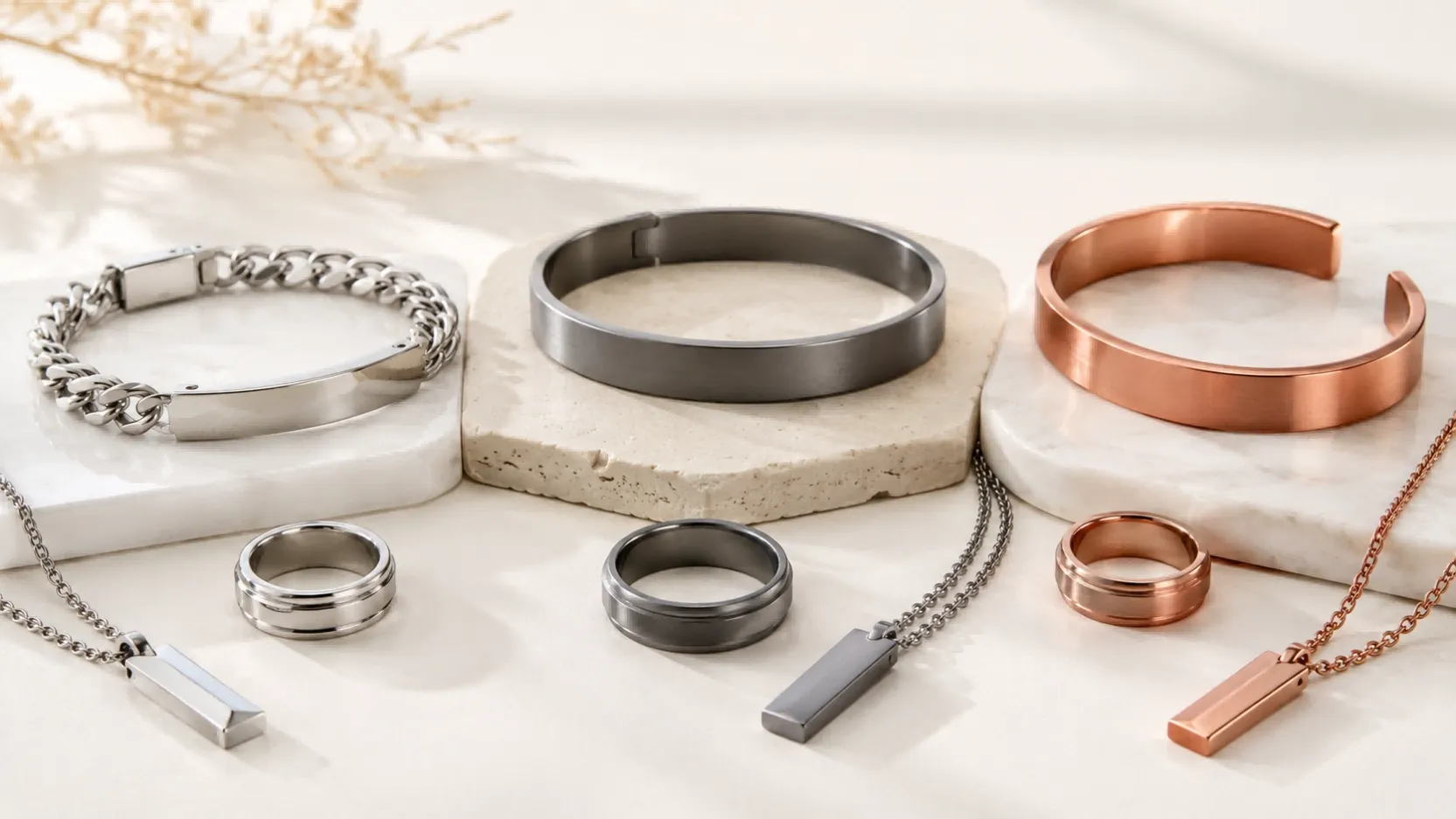
If you are buying jewelry for resale, there is no simple answer to:
“Which material is the best?”
It depends on what you are trying to sell.
A stainless steel bracelet, a titanium bracelet and a copper bracelet can all be good products, but they are usually chosen for different reasons.
We work with all three materials, and buyers often ask us which one they should start with.
Our answer is usually:
Start with your customer, not the material.
A fashion store, a magnetic jewelry seller and a premium lightweight jewelry brand may all make different choices.
Quick Comparison: Stainless Steel vs Titanium vs Copper
Here is the simple version first.
Material | Main Character | Weight | Price Position | Common Use |
|---|---|---|---|---|
316L Stainless Steel | Strong, versatile, modern | Medium | Accessible to mid-range | Fashion jewelry, magnetic jewelry |
Pure Titanium | Lightweight, clean, premium feel | Light | Mid to higher positioning | Minimalist, lightweight, magnetic jewelry |
99.9% Pure Red Copper | Warm color, distinctive appearance | Medium to heavier | Depends on design | Copper bangles, magnetic jewelry, vintage-inspired styles |
None of these is automatically better.
The question is what your customers expect.
Why Do So Many Wholesale Buyers Choose 316L Stainless Steel?
If you want one material that can cover many jewelry categories, 316L stainless steel is usually the easiest place to start.
It works well for:
- bracelets
- bangles
- rings
- necklaces
- anklets
- earrings
- magnetic jewelry
- non-magnetic fashion jewelry
One reason buyers like stainless steel is design flexibility.
It can be made into very simple pieces or combined with:
- CZ
- carbon fiber
- shell
- gold foil details
- different surface textures
- magnetic elements
It also works well with different finishes.
For many of our colored stainless steel products, we use PVD plating.
That gives buyers more options if they want silver, gold, rose gold, black or mixed-color designs.
When Is Stainless Steel a Good Choice?
Stainless steel makes sense if your customers want:
More styles at an accessible price point.
For example, if you run an online store and want to test 20 bracelet designs, stainless steel gives you a lot of design variety.
It is also practical for wholesalers who want one material covering both men's and women's collections.
We often see new buyers start with stainless steel because it allows them to test different looks without narrowing themselves to one very specific market.
What Makes Titanium Different?
The first thing most people notice about titanium is the weight.
Pick up a similar-size stainless steel bracelet and titanium bracelet, and the titanium version usually feels noticeably lighter.
That matters more than it sounds.
Some customers specifically like jewelry that feels light on the wrist, especially for wider bracelets or everyday designs.
Titanium also has a slightly different market position.
It can feel more technical, minimal or premium compared with standard stainless steel.
That is why some buyers prefer it for:
- minimalist jewelry
- men's bracelets
- clean geometric designs
- lightweight collections
- magnetic bracelets
Is Titanium Always Better Than Stainless Steel?
No.
This is one of those questions where the word “better” is not very useful.
Titanium may be better if your customer wants:
- lower weight
- a more premium material story
- minimalist styling
Stainless steel may be better if you want:
- more design options
- broader price flexibility
- a larger ready-stock selection
- easier testing across many styles
We have customers who specifically ask for titanium.
We also have customers who compare the same design in titanium and stainless steel and choose stainless steel because it fits their target retail price better.
Both choices can be correct.
What Should Buyers Know About Pure Copper Jewelry?
Copper is completely different visually.
You usually know immediately when you are looking at a copper bracelet.
It has a warm reddish tone that stainless steel and titanium do not naturally have.
Our copper jewelry range uses 99.9% pure red copper.
Copper is especially common in:
- open bangles
- magnetic bracelets
- simple cuffs
- traditional-style jewelry
- vintage-inspired designs
But it does not have to look old-fashioned.
Modern copper jewelry can also be simple and clean.
Does Copper Change Color?
This is one question buyers should ask before selling copper jewelry.
Copper is a reactive natural metal.
Its surface can gradually change with exposure to air, moisture, skin oils and the environment.
That is part of the material's natural behavior.
So if your customer expects copper to behave exactly like stainless steel, you should explain the difference before selling it.
This is another reason we don't like describing every material as simply:
“Never changes color.”
That kind of promise is too broad.
Different materials behave differently.
It is better for buyers to know what they are actually purchasing.
Which Material Is Best for Magnetic Jewelry?
All three can be used.
We currently make magnetic jewelry in:
- 316L stainless steel
- pure titanium
- 99.9% pure red copper
The base material and the magnetic elements are two separate things.
For example, you can have:
- stainless steel magnetic bracelet
- titanium magnetic bracelet
- copper magnetic bangle
The inside may then contain neodymium magnets or, depending on the design, a 4-in-1 element configuration.
So don't assume:
“Magnetic bracelet = copper bracelet.”
That used to be a common association, but there are now many stainless steel and titanium magnetic designs as well.
What About Non-Magnetic Fashion Jewelry?
This is also important for our buyers.
The same base materials can be used without magnetic or other added elements.
For example:
A stainless steel bracelet can be:
Magnetic jewelry
or simply:
Fashion jewelry with no magnetic elements.
The same idea applies to titanium and copper.
This gives wholesalers more flexibility because you don't need completely separate suppliers for every product category.
You can build one collection around material and another around product function or style.
Which Material Gives Me More Design Choices?
In our experience, stainless steel usually offers the widest variety.
There are many existing shapes, chains, clasps and decorative options available.
Titanium has strong design potential too, but ready-stock selections are often more focused.
Copper tends to be more specialized, especially in magnetic bangles and bracelets.
If you are new to jewelry wholesale and don't know which direction your customers will prefer, a mixed-material test can actually be more useful than choosing one material immediately.
For example:
- 8 stainless steel styles
- 6 titanium styles
- 6 copper styles
Then compare actual customer response.
Sometimes the market decides very differently from what you expected.
Which Material Is Cheapest?
Buyers ask this all the time.
But the material alone does not decide the final price.
A simple stainless steel bracelet may cost less than a complicated titanium design.
But a stainless steel bracelet with heavy CZ decoration, complex machining or special finishes may cost more than a very simple titanium piece.
Price can also depend on:
- product weight
- structure
- plating
- stones or decorative materials
- clasp design
- magnetic elements
- polishing
- order quantity
- customization
So when comparing quotations, compare similar products.
Don't compare:
“stainless steel price”
with:
“titanium price”
as if every product were identical.
Ask for a quotation based on an actual model.
What About Plating?
This matters especially if you want colored jewelry.
Many buyers ask for:
- gold
- rose gold
- black
- two-tone finishes
For many of our stainless steel and titanium designs, PVD plating is used.
But plating performance also depends on the product, surface preparation, usage and environment.
If you are building a branded collection and color consistency matters, tell the supplier.
A repeat order should not be treated like a completely unrelated production batch.
How Should a Small Business Choose?
If you are still unsure, here is a practical way to think about it.
Choose Stainless Steel If:
You want:
- broad style selection
- fashion and magnetic options
- multiple finishes
- easier price positioning
- a good material for testing many designs
Choose Titanium If:
You want:
- lightweight products
- clean designs
- a more premium material story
- men's or minimalist jewelry
- lightweight magnetic bracelets
Choose Copper If:
You want:
- a distinctive warm metal color
- magnetic bangles
- traditional or vintage-inspired products
- something visually different from common steel jewelry
And if you still don't know?
Test all three.
That is often more useful than trying to decide everything from photos.
Can I Mix Stainless Steel, Titanium and Copper in One Wholesale Order?
For our available ready-stock products, different materials and styles can be mixed.
Our standard starting quantity for many ready-stock styles is:
5 pcs per style.
This means you don't necessarily need to choose one material for the whole order.
A small buyer could test:
- stainless steel bracelets
- titanium bracelets
- copper bangles
- rings
- necklaces
in the same purchasing stage.
Stock availability should always be confirmed before the order is finalized.
For available ready-stock products, shipment can normally be arranged in around 3–7 days.
What Should You Ask Your Supplier?
Before choosing a material, ask your supplier:
What is the actual base material?
Don't rely only on the product title.
Is the product solid material or plated over another base metal?
These are not the same thing.
What finish or plating process is used?
Especially for gold, rose gold and black products.
Can I see real photos?
Material appearance can look different in heavily edited catalog images.
What does the product actually weigh?
This is particularly useful when comparing titanium and stainless steel.
Is it in stock?
A good material choice doesn't help if you need delivery next week and the product takes a month to manufacture.
Don't Choose a Material Only Because It Sounds Premium
This is probably the biggest point.
A more expensive material doesn't automatically create a better-selling product.
We have seen simple stainless steel designs sell very well.
We have also seen customers specifically come back for titanium because their buyers liked the light weight.
Copper has its own audience too.
Your job is not to find the material that sounds best.
Your job is to find the combination of:
material + design + price + customer
that works in your market.
That usually takes some testing.
Start With a Small Material Test
If you are buying wholesale jewelry for the first time, you don't need to make a permanent decision between stainless steel, titanium and copper.
Start with a few designs from each material.
Put them in front of real customers.
Then look at:
- which products get clicked
- which products sell first
- which colors move faster
- which price points customers accept
- which products get reordered
That information is much more useful than a supplier telling you:
“This material is the best.”
At Tai Mei Future, we manufacture and supply jewelry in 316L stainless steel, pure titanium and 99.9% pure red copper, including both magnetic / 4-in-1 jewelry and non-magnetic fashion jewelry.
Many ready-stock products start from 5 pcs per style, with mixed styles and materials supported.
For buyers who find a successful product and want to take the next step, OEM/ODM options are also available for logo, packaging, finishes, sizing and product development.