
Sep 18, 2026Reorder & OEM
OEM Jewelry Manufacturer in China: Custom Jewelry Process Guide
Looking for an OEM jewelry manufacturer in China? Learn how custom jewelry moves from design and sampling to production, QC, packaging and shipping.
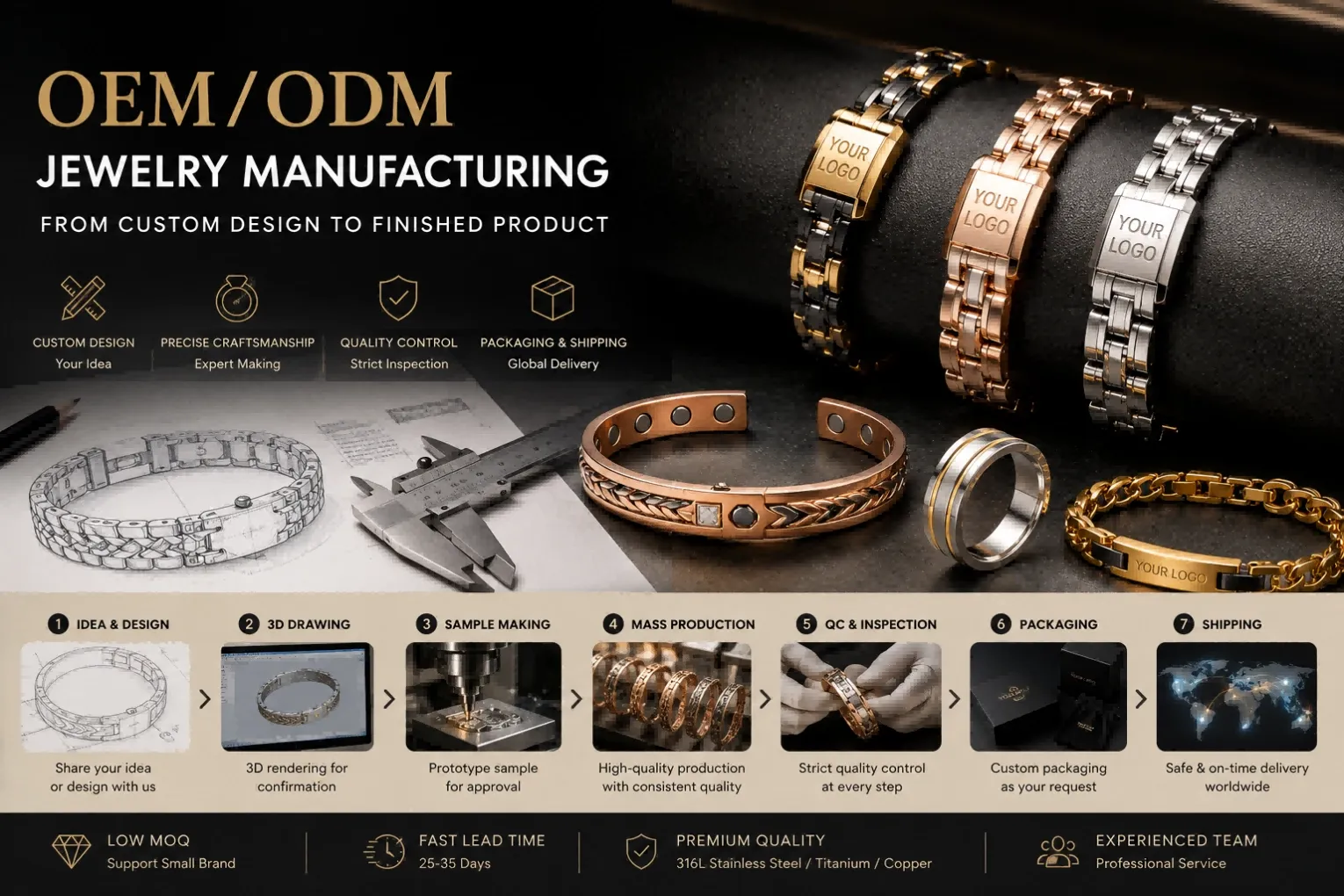
A buyer once sent us a bracelet photo and asked:
“Can you make this with my logo?”
That was a fairly simple OEM request.
Another buyer sent a hand drawing and said:
“I want something similar, but thinner, lighter, black and gold, with magnets inside and my own clasp.”
That is a very different project.
Both are called custom jewelry.
But they do not require the same amount of work, the same MOQ or the same production time.
This is why the first question we usually ask is not:
“How many pieces do you want?”
It is:
“What exactly do you want to change?”
What Does OEM Jewelry Manufacturing Actually Mean?
OEM jewelry manufacturing usually means producing jewelry according to a buyer's specific requirements.
But customization can happen at very different levels.
For example:
Simple Customization
You keep an existing product and change only:
- logo
- packaging
- label
- card
- pouch
Product Modification
You start from an existing design and change:
- length
- width
- plating color
- stone color
- clasp
- surface finish
- magnetic configuration
New Product Development
You create something that does not currently exist in the factory's product range.
This may involve:
- drawings
- CAD development
- prototypes
- new molds
- custom components
- repeated sample revisions
Calling all three “OEM” is fine.
But buyers should understand that the cost and process are very different.
Should I Customize an Existing Jewelry Design or Start From Zero?
For many small and medium buyers, modifying an existing design is the more practical first step.
Why?
Because some of the production questions have already been solved.
The factory may already know:
- how the clasp works
- how the links connect
- how the product is polished
- where a logo can be placed
- how the product fits
- what tooling is available
Then you can focus on the parts that make the product yours.
For example:
Existing bracelet + your logo + different PVD color + custom packaging
can often be much simpler than developing a completely new bracelet structure.
That does not mean you should never create a new design.
It just means:
New does not automatically mean better.
Sometimes a small modification is enough.
What Information Should I Send a Jewelry Factory?
You do not need a perfect technical drawing before contacting a factory.
A good starting package can include:
- product photo
- sketch
- dimensions
- preferred material
- logo file
- color reference
- quantity
- packaging idea
- similar product reference
Even a clear phone photo with notes can be useful.
For example:
“Keep this bracelet shape, make it 10 mm wide instead of 12 mm, change it to black PVD and put my logo on the clasp.”
That is already much more useful than:
“I need a custom bracelet. Please quote.”
The more specific the request, the easier it is to estimate the cost correctly.
Step 1: Confirm the Material
Material should be confirmed before a product goes too far into development.
At Tai Mei Future, our main jewelry materials are:
- 316L stainless steel
- pure titanium
- 99.9% pure red copper
The same design cannot always be copied directly from one material to another without adjustment.
For example, a titanium bracelet may need a different manufacturing approach from a stainless steel version.
Material affects:
- weight
- machining
- surface finishing
- price
- production method
- product feel
So if you send a reference photo, also tell the factory what material you expect.
Step 2: Confirm the Dimensions
Photos are not enough.
A bracelet that looks perfect on screen may feel too wide or too heavy when you actually hold it.
Before sampling, confirm practical measurements such as:
- total length
- width
- thickness
- inner size
- ring diameter
- chain length
- clasp size
For bracelets, even a few millimeters can make a noticeable difference.
This becomes especially important if your market has specific sizing requirements.
Step 3: Decide What Really Needs to Change
One mistake we see is trying to customize everything at once.
A buyer may request:
- new material
- new width
- new clasp
- new plating
- new logo
- new packaging
- new magnets
- new stone
That is possible.
But every change creates another variable.
If your current product already sells well, sometimes changing only two or three things creates a much safer OEM project.
A useful question is:
“Which part of this product actually needs to be different for my brand?”
That keeps development focused.
Can I Add My Logo to Existing Jewelry?
In many cases, yes.
Logo customization is one of the simpler ways to move from normal wholesale into branded jewelry.
Possible logo positions may include:
- clasp
- inside of bracelet
- back surface
- small metal tag
- packaging
The best position depends on the product.
For example, a very narrow titanium bracelet link may not have enough space for a large logo.
A factory should check the actual structure before confirming the logo size and location.
Can I Customize the Packaging Without Changing the Jewelry?
Yes.
And for some new brands, this is a very practical starting point.
You could keep the jewelry itself unchanged and customize:
- jewelry box
- pouch
- card
- sticker
- label
- barcode
- logo printing
That lets you create a branded presentation without investing immediately in a completely new jewelry structure.
For small businesses, this can be a useful step between:
ready-stock wholesale
and
full custom manufacturing.
When Do I Need a New Mold?
Not every custom project needs one.
A new mold or new tooling may be necessary when:
- the overall shape is new
- the dimensions change significantly
- a special clasp is required
- a new component is being developed
- the existing structure cannot be modified
- the buyer wants an exclusive form
If an existing model can be adapted, it may be possible to reduce development work.
This is why we normally check existing tooling before suggesting a new mold.
New tooling usually adds:
- development cost
- sample time
- higher initial MOQ
- additional confirmation steps
Depending on the project, mold charges may sometimes be discussed as part of a larger production order.
Step 4: Make the Sample
This is one of the most important parts of OEM jewelry development.
The sample turns the idea into something you can actually hold.
That matters because a drawing cannot tell you everything.
Once the sample arrives, you may notice:
“The bracelet feels too heavy.”
or:
“The gold color is too yellow.”
or:
“The logo should be smaller.”
or:
“This clasp is difficult to open.”
This is normal.
The purpose of the sample is not only to prove the factory can make the product.
It is also to find problems before mass production.
What Should I Check on an OEM Jewelry Sample?
Do not inspect only the front.
Check the complete product.
Material
Does it match the agreed specification?
Dimensions
Measure it.
Do not rely only on appearance.
Weight
Especially important for titanium and larger bracelets.
Surface Finish
Check polishing, brushing or plating.
Color
Compare it with your approved reference.
Logo
Check:
- size
- position
- depth
- readability
Clasp
Open and close it several times.
Edges
The jewelry should not feel unnecessarily sharp.
Decorative Parts
Check stones, shell, carbon fiber or other inserts.
Magnetic Elements
For magnetic jewelry, check the inside and confirm the agreed layout.
A small issue in one sample can become a large issue when repeated across hundreds of pieces.
Should I Approve the Sample Before Production?
Yes.
This sounds obvious, but buyers sometimes rush because they want to save time.
If something is wrong with the sample, do not say:
“It is almost okay. Just fix it during production.”
That creates unnecessary risk.
Before production begins, both sides should be clear about:
- final dimensions
- color
- logo
- material
- structure
- packaging
- quantity
Once approved, the sample becomes an important reference for production and quality control.
Why Is OEM MOQ Higher Than Ready-Stock MOQ?
This is one of the most important things for buyers to understand.
For many of our ready-stock items, the starting quantity can be:
5 pcs per style.
But that does not mean a completely customized product can also be made at 5 pcs.
Ready stock already exists.
Custom production may require:
- machine setup
- tooling
- plating batch
- logo processing
- special components
- custom packaging
- new molds
The factory needs enough quantity to make the production run practical.
So OEM MOQ depends on the actual project.
There is no single MOQ that applies to every customized piece of jewelry.
How Much Does Custom Jewelry Cost?
There is no useful answer to:
“How much does OEM jewelry cost?”
without knowing the product.
Price can depend on:
- material
- size
- weight
- structure
- plating
- stones
- magnets
- logo
- mold
- packaging
- quantity
A simple engraved stainless steel bracelet is very different from a newly developed titanium magnetic bracelet with custom tooling.
For a more accurate quotation, send the factory the actual project details.
How Long Does OEM Jewelry Production Take?
For many of our custom jewelry projects, production normally takes around:
25–35 days after all product details are confirmed.
That range usually refers to production after approval.
New product development can take longer if there are:
- mold requirements
- sample revisions
- complex structures
- special finishes
- custom packaging
- unusual components
If you have a fixed launch date, tell the factory at the beginning.
For example:
“I need the products in my warehouse before November 1.”
That is much more useful than saying:
“Please make it fast.”
What Happens During Production?
The exact process depends on the design.
Typical stages may include:
- raw material preparation
- cutting
- forming
- machining
- polishing
- plating
- stone setting
- magnet installation
- assembly
- logo processing
- inspection
- packaging
A simple copper bangle and a multi-link titanium bracelet do not follow exactly the same production route.
That is one reason lead times should be confirmed for the actual order.
How Should Quality Control Work?
Quality control should not mean only:
“Look at the finished products before shipping.”
Different checks happen at different stages.
Depending on the jewelry, QC may include:
- dimensions
- surface finish
- plating color
- polishing
- stone setting
- clasp function
- magnet layout
- logo
- assembly
- packaging
For OEM production, the approved sample is especially useful.
It gives both the buyer and factory a clear reference.
Instead of saying:
“Please make good quality.”
you can ask:
“Does the production match the approved sample?”
That is much more specific.
What About Custom Magnetic Jewelry?
Magnetic jewelry adds another layer of customization.
Depending on the design, buyers may want to change:
- magnet number
- magnet position
- magnet size
- element layout
- bracelet structure
- 4-in-1 configuration
For our 4-in-1 jewelry, depending on the product, the inside may include combinations of:
- neodymium magnets
- germanium
- far-infrared elements
- negative-ion elements
The exact structure should be confirmed for the actual design.
This is another reason inside-product drawings or samples are important.
What About Custom Stainless Steel Jewelry?
316L stainless steel offers a lot of flexibility.
Common OEM requests include:
- PVD colors
- two-tone finishes
- logo
- CZ
- shell
- carbon fiber
- dimensions
- magnetic elements
- packaging
For buyers who want many design directions, stainless steel is often a practical material to develop.
What About Custom Titanium Jewelry?
Titanium buyers often focus on:
- lightweight feel
- men's designs
- clean shapes
- black or gold finishes
- magnetic structures
- bracelet dimensions
Because titanium has different material characteristics from stainless steel, production requirements should be confirmed specifically for titanium rather than simply copying a steel specification.
What About Custom Copper Jewelry?
Copper OEM projects may include:
- new bangle shapes
- width changes
- surface patterns
- logos
- magnetic layout
- polishing
- packaging
For pure copper, buyers should also understand that the material can naturally change color over time.
That should be considered when building product information and customer care instructions.
Should a New Jewelry Business Start With OEM?
Not always.
If you do not yet know which products your customers like, jumping straight into a large custom collection can create unnecessary risk.
A practical path can be:
Step 1: Order ready-stock products.
Step 2: Test different styles.
Step 3: Identify the best sellers.
Step 4: Customize those products.
Step 5: Add your own logo and packaging.
Step 6: Develop more exclusive designs as sales grow.
That is still building a brand.
You are simply using real sales information before investing more money.
When Does OEM Make Sense From the Beginning?
There are also buyers who should go directly into OEM.
For example:
- an established jewelry brand
- a buyer replacing an existing supplier
- a retailer with a proven design
- a distributor with known demand
- a company developing a private-label collection
If you already know exactly what your market needs, starting from ready stock may not be necessary.
The right approach depends on your stage of business.
Common OEM Jewelry Mistakes
Starting With Too Many Designs
You do not need 30 new molds to launch your first private-label collection.
Changing Everything at Once
Sometimes fewer modifications make a better product.
Approving From Photos Only
A real sample can reveal things photos cannot.
Ignoring Dimensions
A few millimeters matter in jewelry.
Choosing Color From a Screen Only
Screens show colors differently.
Forgetting Packaging Until the End
Custom packaging can add production time.
Assuming Ready-Stock MOQ Applies to OEM
It usually does not.
Rushing Sample Approval
A bad sample does not become a good product simply because production starts.
What Should I Ask an OEM Jewelry Manufacturer in China?
Before starting, ask questions that relate directly to your project.
Can you work with my required material?
Can you modify an existing design?
Do I need a new mold?
What is the sample process?
What is the MOQ for this specific design?
What is the estimated lead time?
Can you add my logo?
Can you make my packaging?
How will production be checked against the approved sample?
These questions tell you much more than asking:
“Are you a professional OEM factory?”
Almost every supplier will answer yes to that.
What Makes a Good OEM Relationship?
Clear communication.
Not fancy presentations.
If something cannot be done, the factory should say so.
If a new mold is required, the buyer should know why.
If the sample needs adjustment, both sides should agree on the changes before moving forward.
A successful custom project normally has fewer surprises because the important details were discussed early.
From Ready Stock to Your Own Jewelry Collection
Many of our buyers do not begin with a completely original product.
They start with something already in the market.
Then they learn:
Which styles sell?
Which colors work?
Which sizes customers prefer?
After that, the requests become more specific.
Maybe the next order needs:
- a different clasp
- a shorter bracelet
- a black finish
- their logo
- custom packaging
Later, that modified product may become something unique to their brand.
That is a very normal way to develop jewelry.
You do not need to create everything on day one.
At Tai Mei Future, we manufacture jewelry in 316L stainless steel, pure titanium and 99.9% pure red copper, including magnetic / 4-in-1 jewelry and non-magnetic fashion jewelry.
We support OEM/ODM projects including:
- logo
- packaging
- dimensions
- finishes
- plating
- decorative details
- magnetic configurations
- new product development
For customized projects, MOQ is confirmed based on the actual design and production requirements.
Typical production time is around 25–35 days after all product details are confirmed, depending on the project.