
Sep 18, 2026Find a Supplier
Magnetic Jewelry Manufacturer in China: What Buyers Should Know Before Ordering
Looking for a magnetic jewelry manufacturer in China? Learn what buyers should check about materials, magnets, plating, stock, MOQ and OEM options before placing an order.
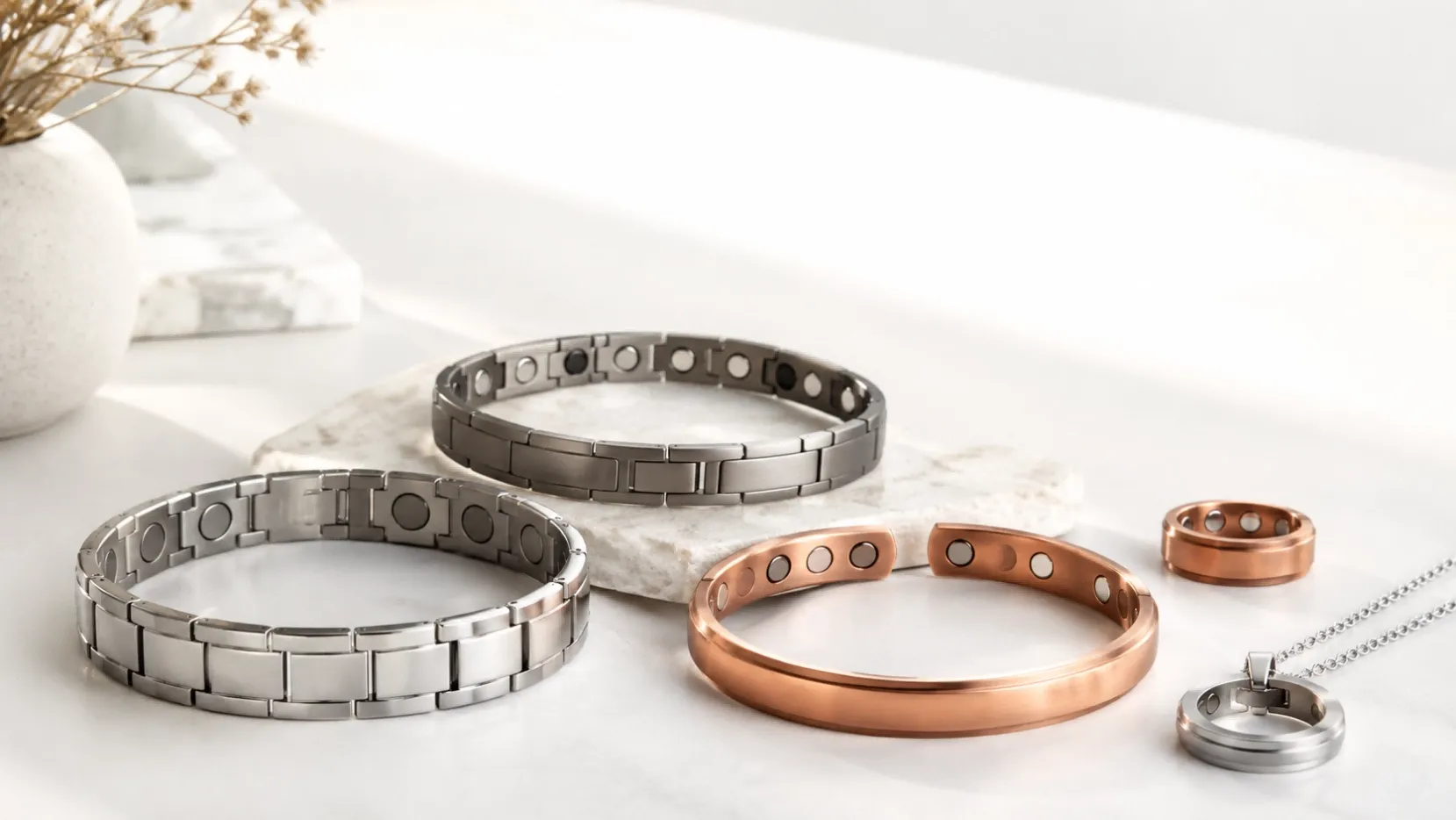
If you are looking for a magnetic jewelry supplier in China, one of the first things you may notice is that many products look similar in photos.
But they are not always made the same way.
Two bracelets can have a very similar appearance while using different base materials, different magnets, different plating processes and completely different inside structures.
So before asking only:
“How much is this bracelet?”
it is worth asking a few more questions.
We manufacture magnetic jewelry ourselves, and these are the details buyers usually care about once they start comparing suppliers seriously.
First, What Do You Mean by Magnetic Jewelry?
For us, magnetic jewelry simply means jewelry designed with magnetic elements built into the inside or back of the product.
These may include bracelets, bangles, rings, necklaces or anklets.
Depending on the design, magnets may be installed individually along the inside of a bracelet or positioned in specific sections of the product.
Some designs use magnets only.
Others are sold as 4-in-1 jewelry, combining several decorative or functional elements such as:
- neodymium magnets
- germanium elements
- far-infrared elements
- negative-ion elements
The exact configuration depends on the product.
This is something worth confirming with your supplier rather than assuming every magnetic bracelet has the same internal structure.
Does the Base Material Matter?
Yes.
Magnetic jewelry is not one single material category.
We currently make magnetic jewelry mainly in:
- 316L stainless steel
- pure titanium
- pure red copper
Each material gives the product a different look, weight and price position.
316L Stainless Steel
Stainless steel is commonly used because it is strong, practical and works with many surface finishes.
It is suitable for both simple designs and more decorative styles with CZ, carbon fiber, shell or other details.
For buyers who want a broad range of styles at an accessible price point, stainless steel is usually a practical place to start.
Pure Titanium
Titanium feels noticeably lighter in the hand.
Some buyers specifically ask for titanium because they want a lighter or more premium-feeling collection.
But don't judge titanium only by the product photo.
If the material is important to your market, ask the supplier clearly what grade or material is actually being used.
Pure Red Copper
Copper gives a completely different appearance.
It is often used for traditional magnetic bangles and bracelets, but modern copper designs can also look quite clean and contemporary.
We use 99.9% pure red copper for our copper jewelry range.
Copper naturally behaves differently from stainless steel or titanium, so buyers should understand the material before selling it to their own customers.
Ask to See the Inside of the Jewelry
This sounds obvious, but it is surprisingly important.
When buying magnetic jewelry online, don't only look at the front.
Ask for:
- front photos
- inside photos
- close-up details
- clasp photos
- magnet placement
- actual product dimensions
The inside often tells you more about the product than the front.
For example, if you are buying a magnetic bracelet, you should be able to see where the magnets are installed and whether the layout matches the product description.
We normally photograph both the outside design and the inside element configuration for this reason.
It makes comparison much easier.
How Strong Are the Magnets?
This is another common buyer question.
The problem is that magnet strength is sometimes used as a marketing number without enough explanation.
If magnet specifications matter to you, ask the supplier:
What type of magnet is used?
For many of our magnetic jewelry designs, we use neodymium magnets.
You can also ask about:
- magnet size
- number of magnets
- position of magnets
- magnet specification for the specific model
Different bracelet designs do not necessarily use the same number or arrangement of magnets.
So a supplier should confirm the actual configuration of the product you are ordering instead of giving one answer for an entire catalog.
Be Careful With Medical Claims
This is especially important if you plan to sell magnetic jewelry online.
Magnetic jewelry is sometimes marketed with very strong health claims.
We don't recommend doing that.
A bracelet should not be presented as something that can diagnose, treat or cure a medical condition unless there is proper regulatory and scientific support for such a claim.
From a sourcing point of view, it is better to focus on what can actually be verified:
- base material
- magnet type
- element configuration
- dimensions
- finish
- construction
- packaging
- product testing or compliance information where applicable
This is much safer than promising customers a result that a jewelry product cannot guarantee.
What About Plating and Color?
For colored stainless steel and titanium jewelry, plating quality matters.
A good-looking sample is not enough.
Ask the supplier which finishing process is used and whether the finish is suitable for the intended product.
We use PVD plating for many of our plated jewelry designs.
Common colors can include:
- gold
- rose gold
- black
- silver-tone finishes
- mixed-color designs
But different products may use different finishes, so the actual specification should always be confirmed for the model you are buying.
If color consistency is important for repeat orders, tell the supplier before production.
That is especially important when you are building a branded collection and need future batches to look consistent.
Can I Buy Magnetic Jewelry in Small Quantities?
For ready-stock products, yes.
Our standard starting quantity for many available magnetic jewelry styles is:
5 pcs per style
Different available designs can also be mixed in one wholesale order.
This works well if you are still deciding whether your customers prefer:
- stainless steel or titanium
- magnetic-only or 4-in-1 styles
- silver, gold or black finishes
- simple or CZ-decorated designs
- men's or women's styles
Instead of putting your whole budget into one bracelet, you can test several.
Then reorder the designs that actually sell.
Ready Stock and Custom Production Are Different
This is something buyers should understand before requesting a quotation.
Ready Stock
Ready-stock jewelry has already been produced.
For available styles, we can normally arrange shipment within around 3–7 days after the order is confirmed.
Stock changes, so availability should always be checked before payment.
OEM / ODM Production
Custom jewelry takes more time.
If you want:
- your own logo
- custom packaging
- a different size
- different plating
- different CZ or decorative material
- a different magnet arrangement
- different 4-in-1 elements
- a completely new design
then the product needs to be discussed separately.
A typical customized production time for our factory is around 25–35 days after the details are confirmed, depending on the design.
New molds or special structures can also affect MOQ, cost and production time.
Can I Add My Own Logo?
Usually, yes.
But there is an important question:
Do you need your logo immediately, or are you still testing the product?
For a new business, we often suggest testing standard ready-stock products first.
If a bracelet sells well, then you have a much better reason to invest in:
- logo engraving
- branded packaging
- custom finishes
- modified sizes
- exclusive designs
There is nothing wrong with building a brand from the beginning.
But there is also nothing wrong with testing first.
It depends on your stage of business.
What Should I Ask a Magnetic Jewelry Manufacturer Before Ordering?
You don't need to send a factory twenty questions.
Start with the practical ones.
1. What is the actual base material?
Ask whether it is stainless steel, titanium, copper or another material.
2. What magnetic elements are inside?
Ask for photos and actual configuration.
3. Are the products really in stock?
If you need fast delivery, confirm stock before ordering.
4. What is the MOQ per style?
Don't assume the advertised MOQ applies to the whole order.
5. Can different styles be mixed?
This matters if you want to test several designs.
6. What plating process is used?
Especially important for gold, black and rose-gold products.
7. Can I see real product photos?
Catalog renders are useful, but real product photos tell you much more.
8. Can I customize the product later?
Even if you don't need OEM today, you may need it after finding a best seller.
These questions usually give you a much clearer picture of the supplier.
How Do You Compare Two Magnetic Jewelry Suppliers?
Price matters.
But don't compare only the price shown in the quotation.
Compare what is actually included.
For example:
Supplier A may quote a slightly lower price, but require 100 pieces per style.
Supplier B may allow 5 pieces per style and mixed designs.
For a large established distributor, Supplier A might still make sense.
For a small retailer testing a new product category, Supplier B may create less inventory risk.
There is no single “best supplier” for every buyer.
The better question is:
Which supplier fits the way you currently buy and sell jewelry?
What We Have Learned From Magnetic Jewelry Buyers
After working with magnetic jewelry for years, we have noticed that buyers usually care about different things at different stages.
At the beginning, they ask:
“What is your price?”
Then:
“What is the MOQ?”
After receiving samples, the questions become much more specific:
“Can you move this magnet?”
“Can you make the bracelet 5 mm longer?”
“Can you make this one in black?”
“Can I put my logo here?”
That is normal.
Once you understand what your customers actually want, sourcing becomes much more specific.
This is also why starting from ready stock can make sense.
You learn the product first.
Then you improve it.
Start With the Product, Not the Promise
If you are sourcing magnetic jewelry from China, don't choose a supplier because they make the biggest health claims or use the most impressive marketing words.
Look at the product itself.
Check:
- material
- construction
- magnets
- inside layout
- finish
- dimensions
- stock
- MOQ
- customization capability
- communication
Those are things you can actually verify.
Tai Mei Future manufactures and supplies magnetic, 4-in-1 and non-magnetic fashion jewelry in 316L stainless steel, pure titanium and 99.9% pure red copper.
For many ready-stock styles, we support 5 pcs per style, mixed orders and approximately 3–7 day shipment, subject to current stock availability.
OEM/ODM options are also available for buyers who want to develop their own products after testing the market.